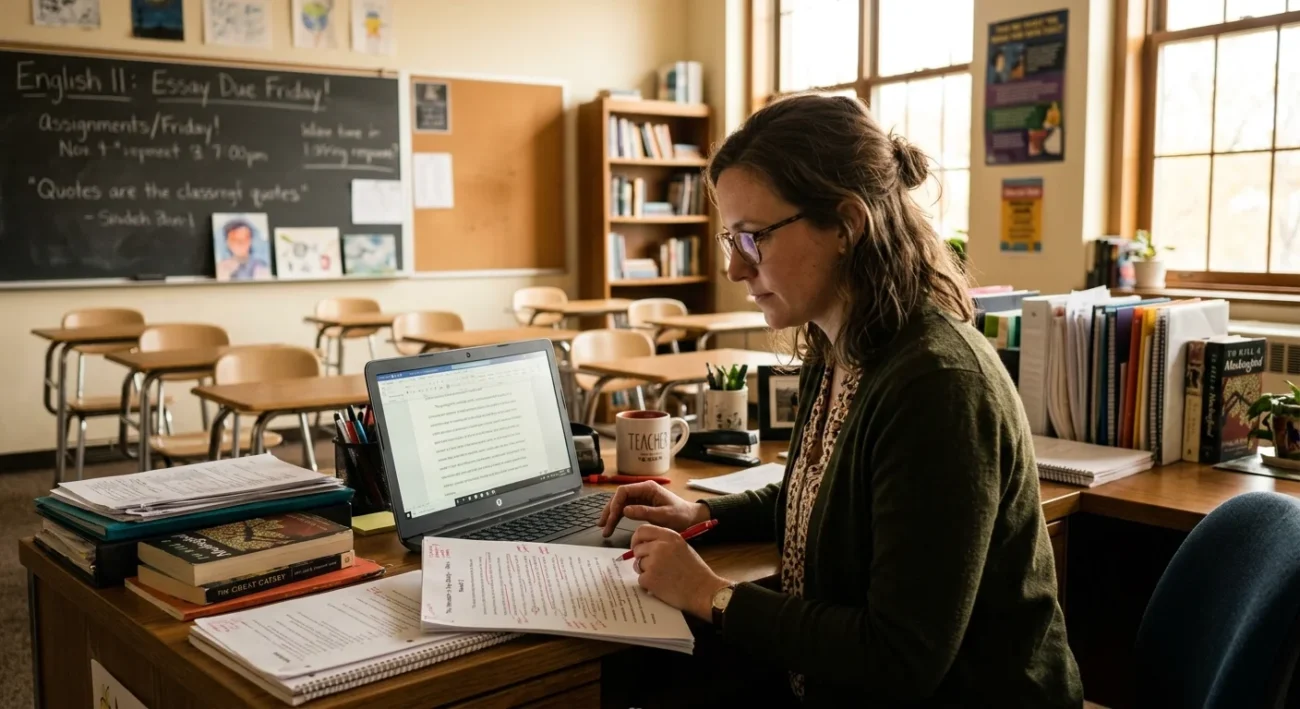
Teachers check for AI by combining three things: detection software such as Turnitin or GPTZero, a review of how the work was written (version history, drafts, in-class samples), and their own judgment about whether the writing sounds like that student. No single method settles the question. Most schools now treat a detector score as a reason to look closer, not as a verdict.
This guide covers each method, what the software actually measures, and where the checks fail. It also explains what usually happens after a teacher gets suspicious, which rarely gets discussed.
The Five Methods Teachers Use Most
Teachers rarely rely on one tool. The checks below tend to stack, and a case usually needs more than one of them to move forward.
The first is an AI detector built into the school’s plagiarism software or bought separately. The second is the document’s edit history. The third is a comparison against the student’s earlier writing. The fourth is a close read for patterns common in chatbot text. The fifth is a short conversation where the student explains their own work.
The order matters. Software is usually the first signal, but the conversation is often the last step, and it carries the most weight.
AI Detection Software
Detectors are the most visible part of the process, so they get the most attention. They are also the least reliable, which is why the rest of this article focuses on alternatives.
1. Turnitin
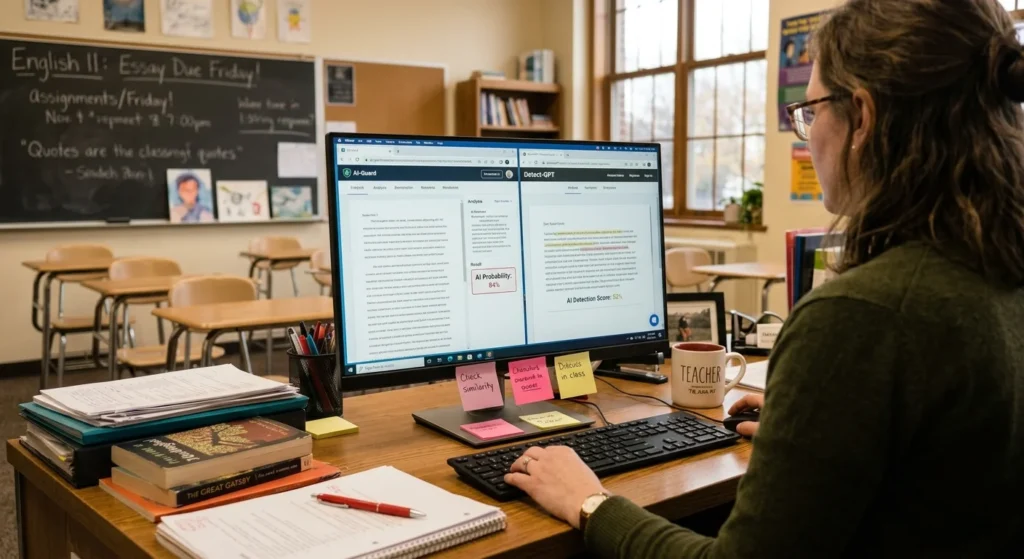
Turnitin added AI writing detection to its existing similarity checker in April 2023. It reports a percentage estimating how much of a submission a large language model likely produced, and it highlights the sentences it flags. The tool needs a minimum amount of text to work, which Turnitin has set at 300 words.
Turnitin has said publicly that its score should not be the only basis for an academic misconduct decision. It has also said that low scores carry a higher chance of false positives, and it marks scores in the lowest range with an asterisk instead of a firm number. Because Turnitin changes its guidance often, teachers and students should check the company’s current documentation.
2. GPTZero, Copyleaks, and Originality.ai
Teachers who lack Turnitin, or who want a second opinion, often paste text into GPTZero, Copyleaks, or Originality.ai. Each returns a probability or a percentage, and most color-code the suspect sentences.
The tools disagree with each other more often than people expect. The same essay can score 5% on one detector and 60% on another. A teacher who runs three detectors and gets three different answers has learned very little, and many experienced teachers say so.
3. What Detectors Measure
Most detectors look at two statistical features of text. Perplexity measures how predictable each word choice is. Text from a language model tends to pick the likely next word, so it scores as low perplexity.
Burstiness measures how much sentence length and structure vary. People tend to mix short, blunt sentences with long, winding ones. Model output is often more even.
Neither feature proves anything about authorship. A careful writer who follows a rigid essay template can produce low-perplexity, low-burstiness text with no AI involved at all.
Why a Detector Score Is Not Proof
A detector produces a probability, and probabilities fail in both directions. The failure that hurts most is the false positive, where human writing is flagged as machine writing.
Vanderbilt University turned off Turnitin’s AI detector in August 2023. The university pointed out that even a 1% false positive rate, applied to the roughly 75,000 papers it submitted each year, would wrongly flag about 750 students. That arithmetic is the main reason many institutions treat the score as a lead and not as evidence.
OpenAI also released its own AI text classifier in early 2023 and withdrew it in July of that year because of its low rate of accuracy. If the company that built the model could not reliably spot its output, a stand-alone detector deserves caution.
The Bias Problem for Non-Native Writers
A 2023 study from Stanford researchers, published in the journal Patterns, tested several popular detectors on essays written by non-native English speakers. The detectors misclassified more than half of the TOEFL essays as AI-generated, while handling essays by native-speaking US students far more accurately. The paper is titled “GPT detectors are biased against non-native English writers.”
The likely reason is the perplexity measure itself. Writers with a smaller English vocabulary tend to use simpler, more predictable word choices, which the detector reads as machine-like. This is one of the strongest arguments against acting on a score alone.
Checking the Writing Process, Not Just the Text
Many teachers have moved toward examining how a document came together, because that is harder to fake than a finished essay. A text pasted into a blank document in one go looks very different from one built over several sittings.
Google Docs and Microsoft Word both keep version history. A teacher can scroll through it and see when each section appeared, how long the student worked, and whether large blocks arrived at once. Browser extensions such as Draftback replay a Google Doc’s edit history as a video of the typing.
Some teachers now ask students to write in a shared document from the start. Others use tools like Grammarly Authorship, which records how text was produced and offers a report the student can share on request.
None of this is perfect. A student can retype a chatbot’s answer by hand, and a student who drafts offline and pastes the final version will look suspicious for innocent reasons. Process evidence works best as one more piece of context.
Comparing the Work to the Student’s Own Voice
The oldest method is still among the most effective. A teacher who has read a student’s writing for months develops a feel for their vocabulary, their usual mistakes, and the length of their sentences.
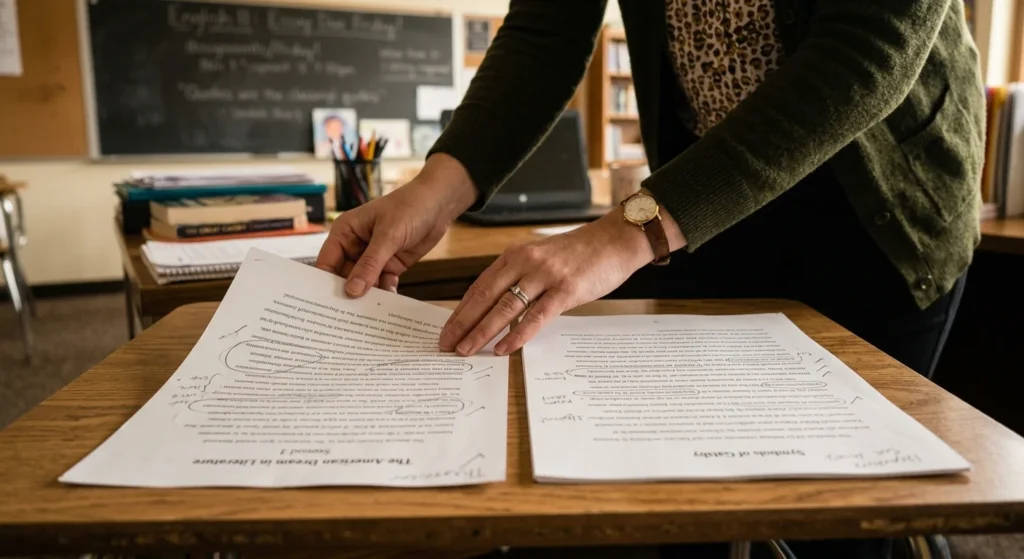
When a polished, error-free essay arrives from a student who normally writes short, uneven paragraphs, the mismatch stands out. Teachers often pull an earlier assignment or an in-class writing sample and read the two side by side.
This method has a built-in weakness. Students improve, get help from tutors and writing centers, and sometimes have a great week. A sudden jump in quality is a reason to ask questions, not a finding.
Signs Teachers Notice When They Read
Experienced readers pick up on certain habits in chatbot writing. These are patterns, not proof, and each one has an ordinary human explanation.
- Paragraphs that all run about the same length and open with a topic sentence that restates the prompt.
- Transition phrases repeated across the essay, such as “Furthermore” or “Moreover,” in places a student would normally just start the next sentence.
- Confident general claims with no specific example, quote, or detail from class.
- Citations that look right but point to articles or page numbers that do not exist.
- A closing paragraph that summarizes everything already said, with no new thought.
The fake citation is the strongest of these, because a teacher can check it in two minutes. If a source does not exist, that is a concrete problem to discuss with the student, whatever the detector says.
A teacher may also notice what is missing. AI text often ignores the specific readings, class discussions, or personal experience the assignment asked the student to use.
The Conversation That Usually Decides the Case
When a teacher is unsure, the most common next step is a short, low-key meeting. The teacher asks the student to explain their argument, define a few terms from the essay, or describe how they found a source.
A student who wrote the piece can usually talk about it comfortably, even if the writing was rough. A student who did not write it often struggles to explain choices that appear on the page.
Good teachers approach this as a question and not an accusation. They ask open prompts like “Walk me through how you built this paragraph” and listen for understanding.
Many schools also have a formal process that follows. That typically includes a written record of the concern, a chance for the student to respond, and review by someone other than the original teacher.
How Assignments Are Changing in Response
Because detection is shaky, a growing number of teachers redesign the assignment instead of trying to catch every case. The goal is to make AI less useful or to make the process visible.
Common changes include in-class writing, handwritten drafts, oral defenses of a paper, and assignments that depend on class-specific material a chatbot has not seen. Some teachers ask for a short reflection on how the student approached the task, or for annotated drafts handed in alongside the final copy.
Other teachers allow AI under stated rules, such as brainstorming or outline help, and ask students to disclose it. Policies vary widely by school, and even by classroom. A student should always read the specific syllabus language before assuming a tool is allowed or banned.
What Students Can Do to Protect Themselves
A student who writes honestly can still be flagged, so a few habits make a false accusation easier to resolve. This is the angle most articles skip, and it matters in practice.
Write in a single shared document, such as Google Docs, so the version history shows steady progress. Keep notes, outlines, and early drafts. Save the sources you read, and keep links or PDFs in a folder.
If a tool like Grammarly or a translation app touched the draft, mention it to the teacher up front. If a score does come back high, ask calmly to see the highlighted sections, and offer your drafts and history as evidence.
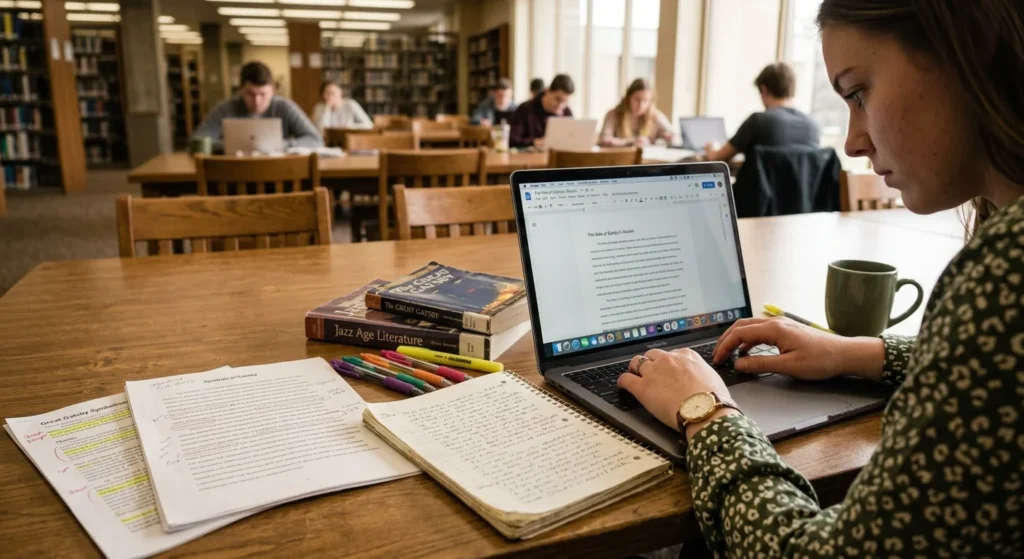
A student who can talk through their own essay in detail is in the strongest position, because it is hard to dispute that you understand what you wrote.