

Machine learning jobs sit among the most sought-after roles in technology. They also confuse many job seekers. Titles overlap and requirements vary widely. The same title at two companies can describe very different work. This guide sorts it out. You will learn which machine learning jobs exist, what each one demands, how pay works, and what hiring managers screen for. You will also see a realistic path in, whether you are a student or a working software engineer.
What machine Learning jobs Involve day to Day
Most machine learning jobs come down to one goal. You turn data into a system that makes useful predictions or decisions. That system might rank search results, flag fraud, recommend a product, or read a medical scan.
The work is less glamorous than it sounds. A large share of any week goes to data. You find it, clean it, label it, and check it for leaks and bias. Training a model is often the shortest step.
After training comes evaluation. You test whether the model works on data it has never seen. Then you ship it, monitor it, and retrain it as the world changes. A model that scores well in a notebook and fails in production is a common and expensive outcome.
This is why employers value people who understand the full lifecycle. Strong theory helps. Working software habits help just as much.
Types of Machine Learning jobs and How they Differ
Titles blur together, so focus on the work behind them. Five families cover most openings.
1: Machine Learning Engineer
This is the most common of the machine learning jobs. Engineers build, train, and deploy models inside real products. Expect heavy Python, frameworks such as PyTorch or TensorFlow, and plenty of software engineering. If you like shipping code more than reading papers, start here.
2: Data Scientist
Data scientists lean toward analysis and experimentation. They frame business questions, run A/B tests, and build models when a model is the right answer. Many roles at smaller companies use this title for what is really a machine learning engineer role. Read the responsibilities, not the title.
3: Research Scientist
Research scientists push methods forward. They read papers, design new architectures, and publish. Most of these roles ask for a PhD or an equivalent research record. Competition is intense, and openings are fewer than in engineering.
4: MLOps Engineer
MLOps engineers run the machinery around models. They build training pipelines, feature stores, deployment systems, and monitoring. Their background is usually DevOps or data engineering. Demand is steady because every deployed model needs someone to keep it healthy.
5: Applied Scientist and AI Engineer
Applied scientists sit between research and product. AI engineers, a newer title, build applications on top of large language models. That means retrieval systems, prompt design, evaluation harnesses, and fine-tuning. The role needs less math than research and more product sense.
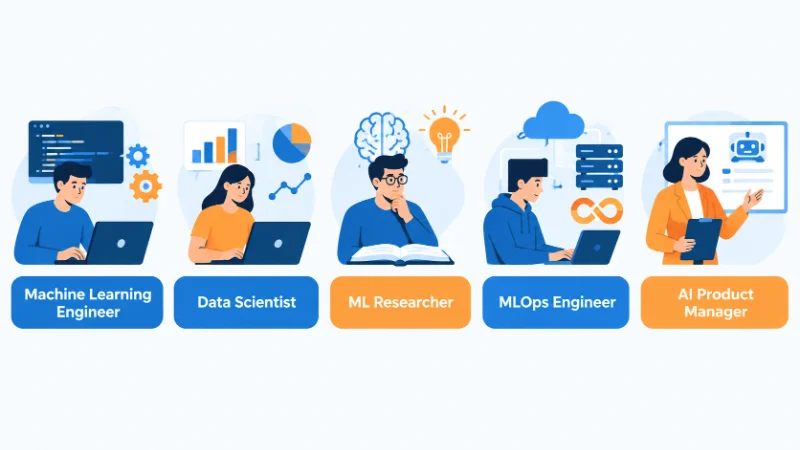
Pick by daily work. If you enjoy statistics and business questions, choose data science. If you enjoy open-ended problems, look at research.
Skills Employers Want in Machine Learning Jobs
Technical Foundation
Python is the baseline. You also need working knowledge of NumPy, pandas, and scikit-learn. Deep learning roles add PyTorch. SQL matters more than most candidates expect, because data lives in databases.
Math is the second layer. Linear algebra, probability, and basic calculus explain why models behave as they do. You do not need to derive everything from scratch. You do need to recognize overfitting, bias, variance, and a leaky validation split when you see one.
Production Skills that Set Candidates Apart
Many applicants can train a model in a notebook. Fewer can put one into service. Learn Git, Docker, and basic cloud use on AWS, Google Cloud, or Azure. Learn how to expose a model through an API and track experiments with a tool such as MLflow or Weights & Biases.

Evaluation skill is the other differentiator. Choose metrics that match the business cost of errors. A fraud model with high accuracy can still be useless if it misses most fraud. Interviewers probe this often.
What Machine Learning Jobs Pay
Pay varies more in this field than in most. Several factors drive the spread.
Location matters. Companies in high-cost metros such as the Bay Area, Seattle, and New York pay the most. Remote roles increasingly adjust pay by region.
Employer type matters. Large technology firms and quantitative finance shops sit at the top. Startups pay less base salary but add equity, which may or may not become valuable. Non-tech employers such as hospitals and manufacturers pay closer to standard software rates.
Seniority and specialty matter. Research scientists with strong publication records and engineers who have shipped large-scale systems command premiums. Roles tied to large language models have recently drawn especially strong offers.
Total compensation is more than base salary. Compare bonuses, equity vesting schedules, and benefits before you judge an offer.
Where Machine Learning Jobs are Found
Tech hubs still hold the largest concentration. The Bay Area, Seattle, New York, Boston, and Austin all post steady openings. Los Angeles has grown through media, adtech, and entertainment technology.
Industry matters as much as city. Finance hires for fraud detection and trading research. Healthcare hires for imaging and clinical prediction. Retail and logistics hire for demand forecasting and routing. Automotive and robotics companies hire for perception and planning.
Remote and hybrid options exist, but they are more competitive because any applicant can apply. Expect more screening rounds for fully remote roles. Government and defense employers add another path, though many of those roles require citizenship and a security clearance. That is worth knowing early.
How to Get an Entry-Level Machine Learning Job
Entry-level machine learning jobs are scarce compared with the interest they attract. Many junior listings still ask for two or three years of experience.
Degree or no Degree
A master’s degree in computer science, statistics, or a related field opens the most doors, especially for research and applied science roles. A bachelor’s degree plus strong projects can land engineering roles. Self-taught candidates can succeed, but they need a stronger portfolio and usually a stepping stone.
That stepping stone is often an adjacent job. Software engineers, data analysts, and data engineers move into machine learning by taking on modeling tasks inside their current company. This route is slower to start and faster to convert than cold applying.
Portfolio Projects that Get Interviews
Hiring managers see the same projects constantly. Titanic survival and handwritten digit classifiers do not stand out. Build something with a real dataset, a clear question, and an honest evaluation.

Good projects share traits. They start from messy data you collected or cleaned yourself. They compare a simple baseline against a complex model. They include a deployed demo, even a small one. They explain what failed. A short write-up on your reasoning matters more than a leaderboard score.
Two or three finished projects beat ten abandoned notebooks. Put the code on GitHub with a clear README.
How to Search for Machine Learning Jobs
Search broadly, because the same work hides under many titles. Try machine learning engineer, applied scientist, AI engineer, data scientist, research engineer, and MLOps engineer. Add terms like computer vision, NLP, recommendation systems, or forecasting to narrow by domain.
Big job boards give volume. Startup-focused boards surface smaller teams that hire faster and care less about pedigree. Company career pages often post roles days before aggregators do.
Read each listing for signals. A description full of production terms such as pipelines, latency, and monitoring means an engineering role. Heavy language about publications means a research role. A vague listing that promises AI without detail can signal a team that has not decided what it needs.
Apply with a tailored resume. Mirror the listing’s tools, lead with shipped results, and keep it to one page. Message engineers at target companies, and ask a specific question about their work rather than asking for a job.
The Machine Learning Interview Process
Expect four stages at most companies. A recruiter screen comes first. A coding round follows, usually in Python with data structures and algorithms. Then comes a machine learning round on fundamentals, such as regularization, evaluation metrics, and model selection. Senior candidates also face a system design round, where you design an end-to-end pipeline for a problem like feed ranking.
Prepare for the practical side. Practice explaining a past project from data collection to deployment. Interviewers dig into decisions: why that model, why that metric, what you would change. Vague answers expose shallow work fast.
When Machine Learning Jobs are Not the Right Fit
This career is not for everyone, and the honest version helps you decide. Many roles involve more data cleaning and infrastructure than modeling. If you want to spend your days on novel algorithms, only a small share of positions offer that.
The field also moves quickly. Tools that were standard three years ago are already dated. You must keep learning on your own time. If that sounds tiring rather than exciting, consider data engineering or analytics engineering. Those paths pay well and change more slowly.