

So, what do AI glasses do? They pair a camera, microphones, and small speakers with an AI assistant, so you can take photos, ask questions, translate speech, and make calls without touching your phone. Some newer pairs also add a tiny display inside the lens. They still rely on your phone for most of the heavy lifting.
The Short Answer in Plain Terms
AI glasses look like regular eyewear but work like a voice-controlled assistant you wear. You say a wake phrase, ask a question, and hear the reply through speakers built into the frame arms.
Most pairs sold in the US today fall into two groups. Camera-and-audio models, such as the Ray-Ban Meta Gen 2 at $379 and up, have no screen. Display models, such as the $799 Meta Ray-Ban Display, show text and visuals in one lens.
How AI Glasses Actually Work
According to a Gulf News overview of the Ray-Ban Meta line, the frames hold a 12MP camera, five microphones, and open-ear speakers. TechPP reports that the Meta Ray-Ban Display runs on the Qualcomm Snapdragon AR1 Gen 1 chip.
The glasses connect to your phone over Bluetooth and Wi-Fi. Bigger AI tasks, like answering an open-ended question, usually travel through your phone to a cloud service. That is why a weak signal can make replies slow.
The speakers sit near your ears, not inside them. You hear the assistant and still hear traffic and the people around you.
What AI Glasses Can Do Day to Day
1. Take Photos and Video Hands-Free
Say a voice command or tap the frame, and the camera captures what you see from your own eye level. Gulf News, citing Wired, notes that Ray-Ban Meta Gen 2 supports 3K Ultra HD video.
This helps when your hands are full, like a parent filming a toddler or a cyclist recording a route. Clips save to a companion app on your phone.

2. Answer Questions About What You See
This is the feature that earns the “AI” label. You can ask the assistant to read a sign, explain a menu, or describe an object, and it uses the camera view to respond. Mark Zuckerberg has said the goal is for AI to see what you see and hear what you hear.
Answers are not always correct. Treat plant, mushroom, or medication identification as a starting point, and confirm with a reliable source before acting on it.
3. Translate Speech and Show Live Captions
Live translation is one of the most practical features for travelers and for anyone who talks with people in another language. Display models can also show live captions in the lens, so you read what someone says as they say it.
Supported languages change with software updates. Check the current list before you rely on it for a trip.
4. Handle Calls, Messages, and Music
You can answer calls, dictate texts, and play music or podcasts by voice. Digit’s coverage of the Display launch adds that those models show incoming messages and track details in the lens.
This works well on a commute or while cooking. It works less well in a loud room, where the microphones pick up background noise.
5. Give Directions and Notifications on Display Models
With a lens display, walking directions appear in your field of view, so you glance up instead of down at a phone. Mezha reports that the Meta Ray-Ban Display also handles video calls and shows Meta AI replies in the lens.
The $799 price includes a Neural Band wristband that reads small muscle signals, so you control the glasses with subtle finger movements. Android Authority lists its battery life at up to 18 hours and says the glasses case extends the glasses’ own battery to as much as 30 hours.

Three Types of AI Glasses You Will See
MobileSyrup, relaying Meta’s own breakdown, sorts the category into three groups.
1. Camera AI Glasses
These include the standard Ray-Ban Meta and Oakley Meta styles. They have a camera, microphones, and speakers but no screen. They look the most like ordinary glasses and cost the least. The sports-focused Oakley Meta Vanguard launched at $499.
2. Display AI Glasses
The Meta Ray-Ban Display is the main example. A color screen sits in the right lens and is visible only to the wearer. The frame is thicker and squarer than the original Wayfarer shape, which is the cost of the extra hardware.
3. Augmented Reality Glasses
True AR glasses, like Meta’s Orion prototype, place 3D graphics over the real world. Orion is a tech preview you cannot buy. TechCabal reported in July 2026 that Google is also working on AI eyewear with an in-lens display.
Who Benefits Most From AI Glasses
Travelers get the most from translation and hands-free photos. Commuters and runners like calls and music without earbuds blocking street noise. Parents, cooks, and tradespeople like having a camera and assistant that work when their hands are busy.
If you mainly want better audio, they are a weaker fit. A Portuguese retailer’s buying guide, iOutlet, points out that the glasses do not match premium earbuds like AirPods Pro for sound quality or noise cancellation. Think of them as a convenient assistant first and a speaker second.
Limits to Know Before You Buy
Battery is the first one. Digit lists up to eight hours of typical use for Ray-Ban Meta Gen 2, and heavy video recording drains it faster.
Weight is the second. A Built In review notes that Meta’s glasses feel heavier than a regular pair, and prescription lenses add more.
Privacy is the third, and it matters more than most reviews admit. The frames carry a recording indicator light, but bystanders can easily miss it. Some gyms, locker rooms, and workplaces ban camera glasses, so ask before you record.
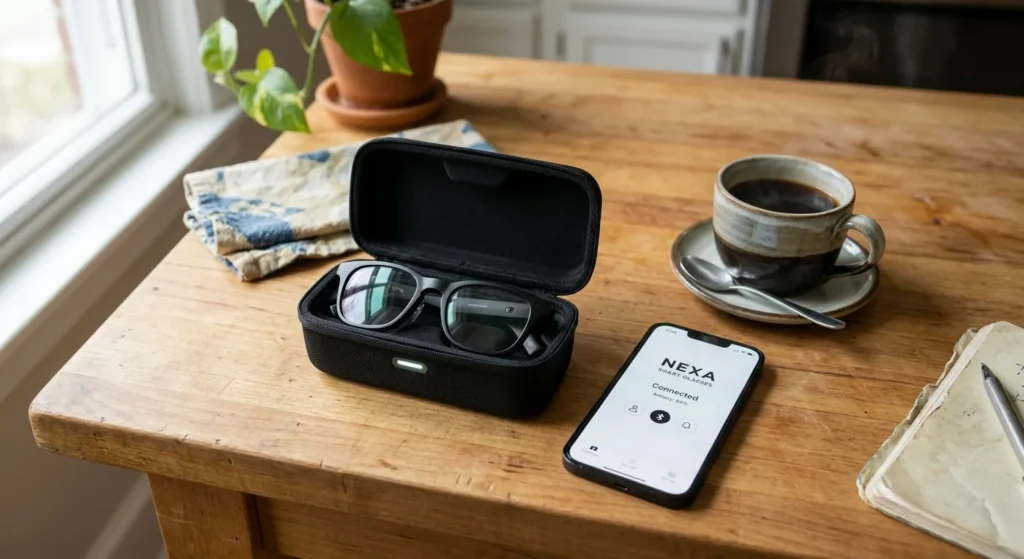
Cost and accuracy round it out. Prices at launch were $379 and up for camera models and $799 for the Display, and the AI can misread what it sees. It also needs a data connection for most tasks.
A Quick Checklist Before You Choose
- Decide if you want a screen. If notifications and directions in your view matter, look at display models. If not, a camera-only pair costs far less.
- Check phone compatibility. Confirm the companion app works with your iPhone or Android before buying.
- Ask about prescription lenses. Confirm the cost and the added weight with the retailer.
- Test the fit. Try them at a store like Best Buy, LensCrafters, or Sunglass Hut if you can.
- Read the return policy. A week of real use tells you more than any spec sheet.