
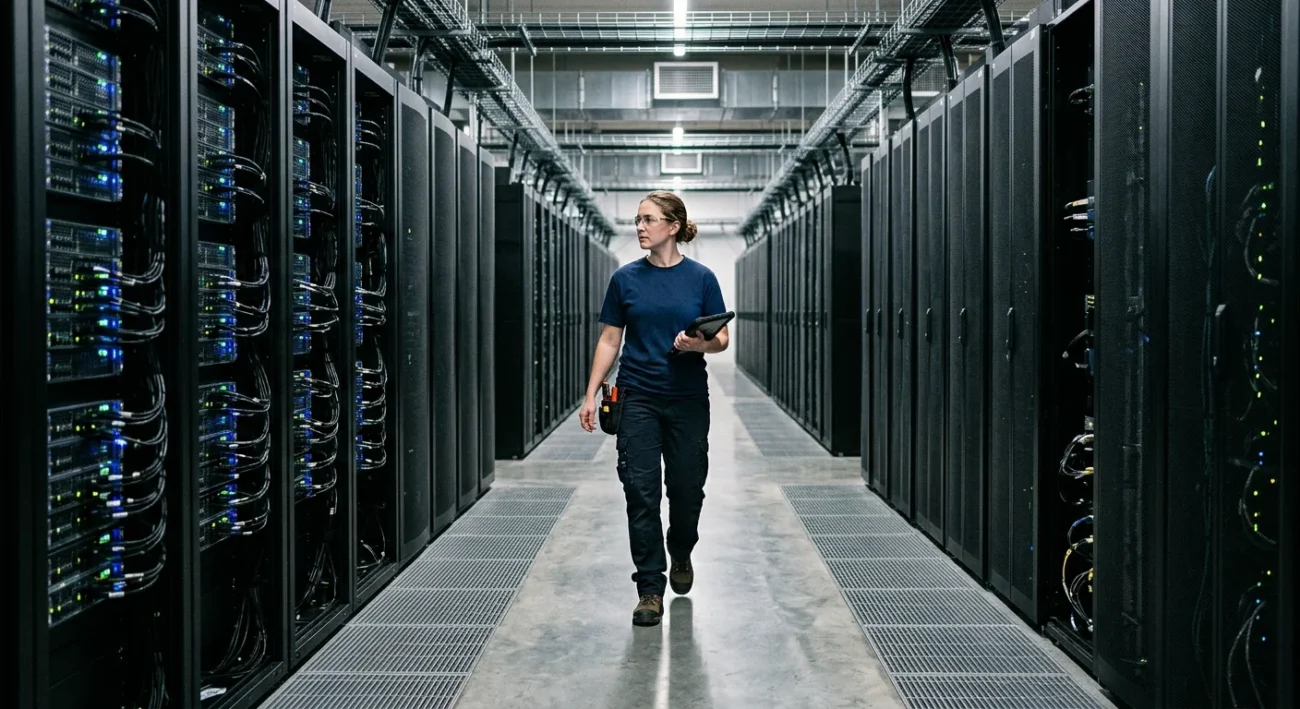
An AI data center is a facility built to run thousands of GPUs or other AI chips in tight clusters, so it can train and serve artificial intelligence models. From the road, it looks like any other warehouse-sized data center. Inside, the whole design is organized around two problems: getting a huge amount of electricity to a small number of racks, and getting the heat out again.
That one difference changes the cooling, the wiring, the network, and where the building can be placed. This guide covers what sits inside one, how it differs from the cloud data centers most people picture, how much power the industry uses in the United States, and how to read the announcements companies make about new sites.
AI Data Center Meaning in Plain Terms
A regular data center stores files, hosts websites, and runs business software. An AI data center spends most of its effort on math at huge scale. Training a large language model means running trillions of calculations across a cluster of chips that have to exchange results constantly.
The chips are mostly graphics processing units (GPUs) from Nvidia and AMD, along with custom accelerators such as Google’s TPUs and Amazon’s Trainium. A GPU works through thousands of small calculations at once, which suits the matrix math inside neural networks. A standard server CPU handles far fewer in parallel.
When you type a question into a chatbot, your request travels over the internet to one of these buildings. A cluster of accelerators reads your text, produces an answer, and sends it back in a second or two. You never see the facility, but every response has a physical address.
Nvidia calls these sites AI factories, which is a marketing label, but it points to something real. The building exists to produce one thing, computation, and every design choice serves that.
How an AI Data Center Differs From a Traditional Data Center
Power density is the biggest gap. According to the Uptime Institute’s global survey, most traditional operators run no rack above 20 kW, and a typical enterprise rack draws well under 10 kW. Nvidia’s GB200 NVL72 puts 72 GPUs in a single rack and draws roughly 120 to 140 kW, based on published industry specification guides, while Uptime’s 2024 survey found only about 1 percent of operators running racks above 100 kW.
| Feature | Traditional Data Center | AI Data Center |
| Rack power | 5 to 15 kW | 60 to 140 kW or more |
| Main chips | CPUs | GPUs and accelerators |
| Cooling | Mostly air | Direct-to-chip liquid plus air |
| Network | Standard Ethernet | High-speed GPU fabrics |
| Typical job | Many small, separate tasks | One large task spread across thousands of chips |
The network matters more than most people expect. During training, GPUs trade data constantly, so a slow link leaves very expensive chips sitting idle. Operators use specialized fabrics such as InfiniBand or fast Ethernet and keep clusters physically close together, often in a single hall.
What Is Inside an AI Data Center
1. GPU Servers and Racks
Each server holds eight or more accelerators, and racks hold several servers. In the newest designs, the rack is the unit of purchase: Nvidia ships the NVL72 as one liquid-cooled system with its 72 GPUs wired together inside. Technicians roll these in whole instead of assembling them server by server.
2. Networking and Storage
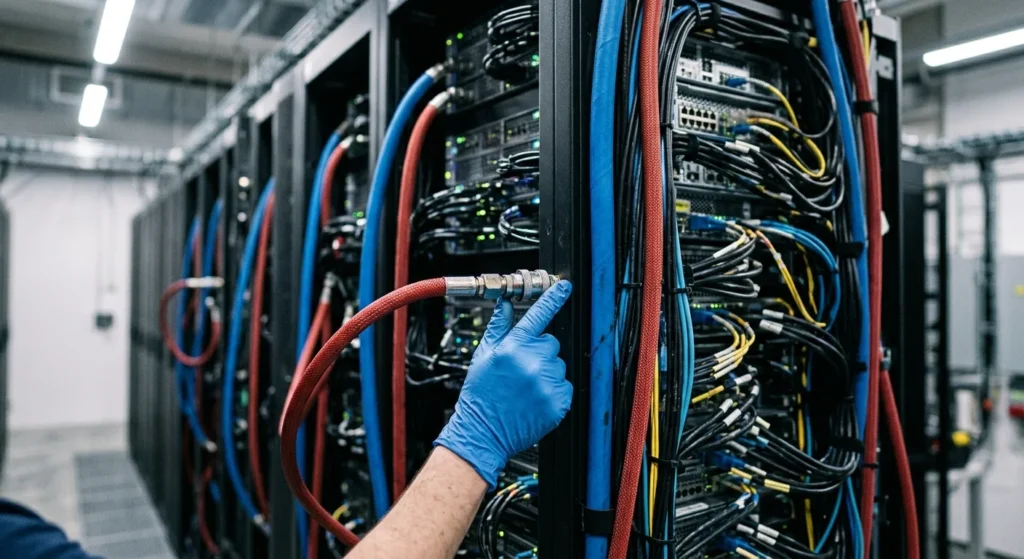
Racks connect through switches arranged so any GPU can reach any other with little delay. Fast storage feeds training data to the cluster, since idle chips waste money by the minute. Fiber runs to outside networks so finished models can serve users.
3. Power Systems
Electricity arrives from a utility substation, passes through transformers and switchgear, and reaches racks through power distribution units. Batteries bridge short outages until diesel or gas generators start. Because AI racks pull so much current, newer sites deliver higher-voltage power directly to the rack.
4. Cooling Systems
Air cooling gets impractical somewhere around 25 to 30 kW per rack. ASHRAE, the engineering society that writes data center thermal guidelines, says in its 2026 AI data center framework that air has hit its practical limit for dense AI systems. It favors liquid or liquid-assisted designs from roughly 50 to 100 kW per rack upward.
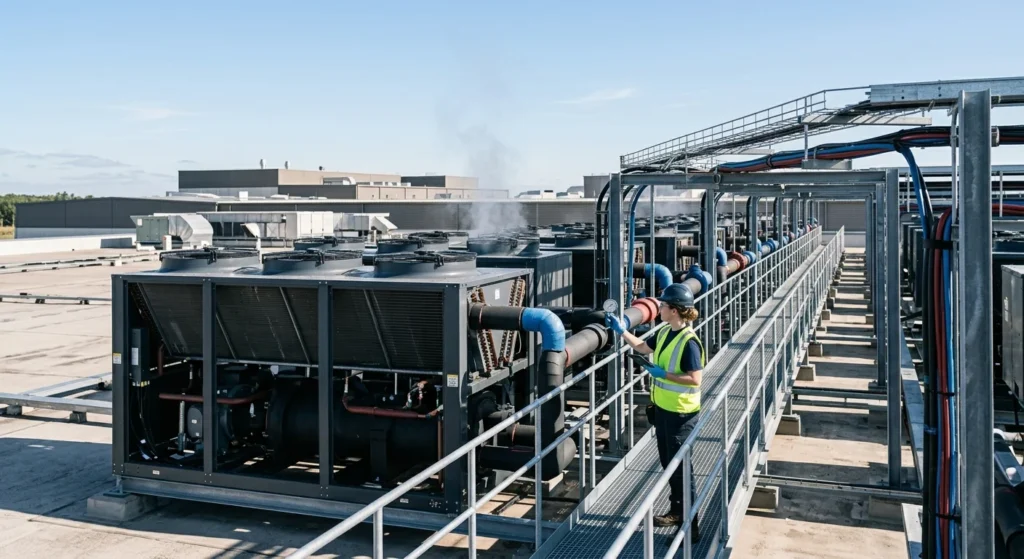
Direct-to-chip cooling pushes coolant through cold plates mounted on the processors. The warmed liquid then travels to heat exchangers, chillers, or cooling towers outside the hall. Air still handles lower-power gear such as network switches, so most sites run both.
Who Builds and Operates These Facilities
Large cloud providers build most of the biggest sites themselves. Amazon Web Services, Microsoft Azure, and Google Cloud rent capacity to customers, while Meta builds for its own products. Each designs campuses around its own models and chips.
A second group leases space. Colocation companies such as Equinix and Digital Realty build the shell, power, and cooling, then rent it to tenants. GPU-focused cloud companies such as CoreWeave rent out the accelerators themselves, often inside leased halls.
Government and university supercomputing centers, including those serving Department of Energy national laboratories, form a smaller third group that uses similar hardware for scientific work. For a business customer, the practical result is that you rarely own an AI data center. You rent time on one through a cloud account or an API call, and the facility stays invisible.
Training Versus Inference: The Two Jobs
Training builds a model. Inference uses one. Training is a large batch job that can run for weeks across thousands of GPUs and depends on tight connections between them. Inference answers your chat message or image request in short bursts and can be spread across many sites.
That split affects where buildings go. Training campuses chase cheap, abundant electricity and can sit far from cities. Inference sites care more about delay, so many sit near population centers and major network hubs.
Training demand grows with every larger model, and inference demand grows with every person who uses one. Plenty of campuses host both jobs, which is one reason the term stays loose. A single facility can be partly traditional cloud and partly AI-dense, with separate halls built to different specs.
How Much Electricity Do AI Data Centers Use?
The best federal estimate comes from Lawrence Berkeley National Laboratory’s 2024 report for the U.S. Department of Energy. It found that data centers used about 176 terawatt-hours in 2023, around 4.4 percent of all U.S. electricity, up from 58 terawatt-hours in 2014. The report attributes much of the jump to AI servers, noting that demand more than doubled between 2017 and 2023.
Looking ahead, the same report projects between 325 and 580 terawatt-hours by 2028, or roughly 6.7 to 12 percent of U.S. electricity. That wide range reflects real uncertainty about how fast AI demand grows and how efficient the chips become.
At the single-site level, power is measured in megawatts. Announced AI campuses now range from tens of megawatts to a gigawatt or more, and a gigawatt is about the output of a large power plant. Grid connection, not land, is usually the longest wait, which is why some developers add on-site generation while utility upgrades catch up.
Efficiency is tracked with power usage effectiveness (PUE), which divides total facility energy by the energy that reaches the computing equipment. A score of 1.0 would mean zero overhead. Google reports a fleet-wide figure near 1.1, while the Uptime Institute’s surveys have put the industry-wide average noticeably higher.
Where AI Data Centers Get Built in the United States
Northern Virginia has long been the largest data center market in the country, and new AI-scale campuses are rising in Texas, Arizona, Ohio, and Georgia, among other states. Developers look for a utility that can deliver hundreds of megawatts, land with room to grow, fiber connections, and a local government willing to approve the project.
State incentives matter too. Many states offer sales tax breaks on data center equipment, and those exemptions have become a point of debate as projects get larger. Cooler climates and water access help with cooling costs, but proximity to power usually wins.
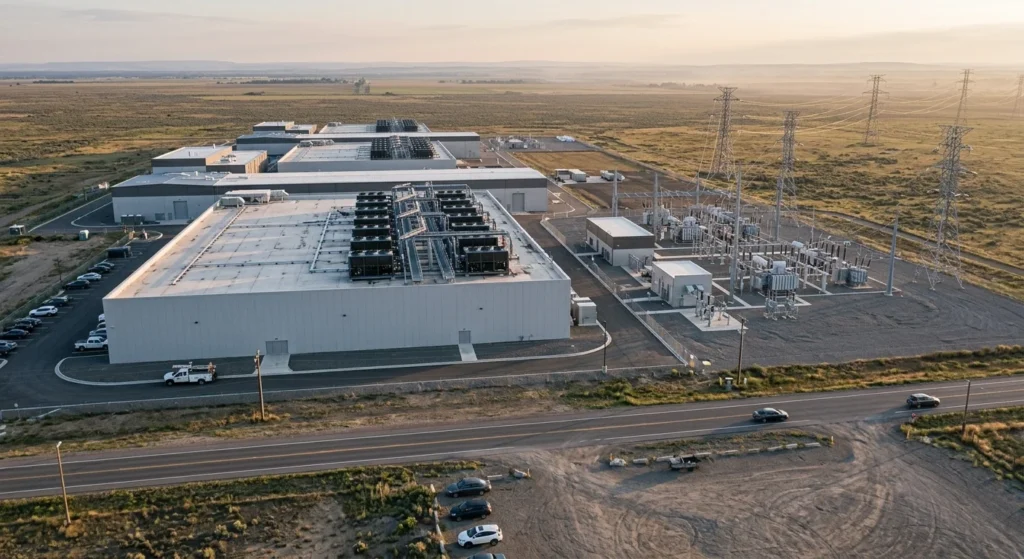
Sites near retired power plants attract interest because the grid connections already exist. The Department of Energy has pointed to former coal plant sites as candidates for this reason. A cheap-electricity site in a hot region often beats a cool site with a congested grid.
What Neighbors and Ratepayers Ask About
Noise comes first for people who live nearby. Cooling fans, chillers, and backup generators can be heard beyond the property line, and zoning hearings often center on it.
Water is the second question. Evaporative cooling uses water directly, while closed-loop liquid systems use far less, so the answer depends on the design of each site. Ask the operator for annual water figures instead of relying on industry averages.
The third is the electric bill. Utilities in some states now require large customers to sign long-term contracts so that grid upgrades are not billed to households. Jobs come up too: a finished campus employs far fewer permanent workers than the construction phase did.
How to Read an AI Data Center Announcement
Press releases use the phrase freely, so a few questions help separate a purpose-built site from a relabeled one.
First, check whether the headline number is megawatts of IT load or total facility power. The two differ because cooling and power conversion take a share, and a project quoted at 100 MW of total power delivers less to the chips.
Second, look for rack density. A hall designed around 10 kW racks cannot host current GPU systems, whatever the brochure says. Retrofits are possible, but they usually mean new electrical work and new cooling.
Third, look at the cooling design. Support for direct-to-chip liquid cooling is the clearest sign a site was planned for current accelerators.
Fourth, find out whether the power is contracted. A campus with a signed utility agreement is a different thing from one with a land purchase and a rendering.
Once those four answers are on the table, the question of what an AI data center is stops being abstract. It is a power plant’s worth of demand, a liquid-cooled GPU hall, and a fast network, packaged as a building.