

An AI chatbot development company builds, trains, and maintains conversational software that talks to your customers, employees, or website visitors on your behalf. The right partner can cut support costs and speed up response times. The wrong one leaves you with a bot that frustrates users and gets turned off within a year.
This guide walks through what these companies actually do, what separates a strong one from a weak one, what the work costs, and what questions to ask before you sign anything.
What an AI chatbot development Company Actually Does
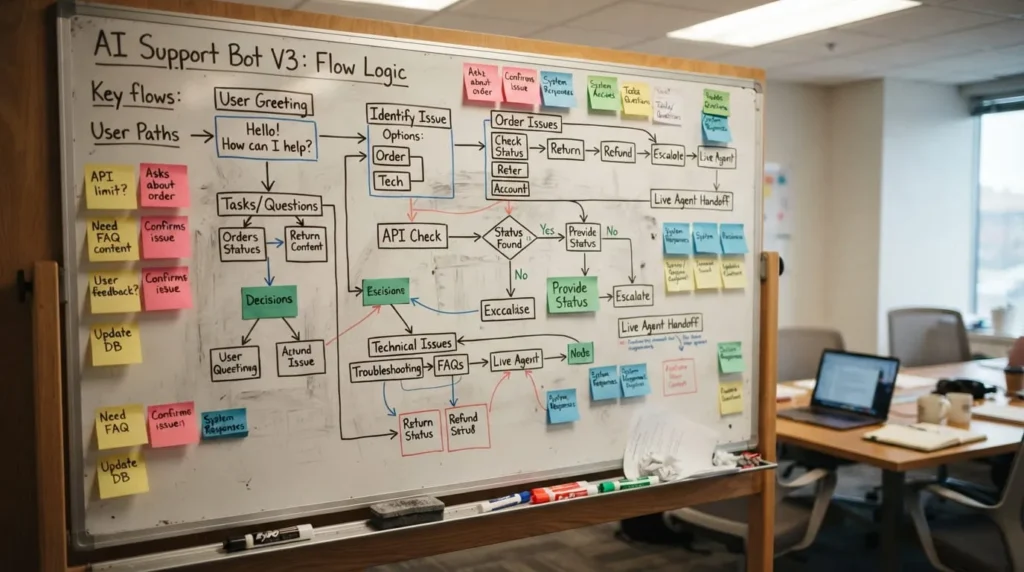
A team handling a chatbot project usually covers four areas: conversation design (mapping out what the bot should say and when), natural language processing (getting the bot to understand messy human input), backend integration (connecting the bot to your CRM, order system, or knowledge base), and ongoing tuning after launch based on real conversations.
Some teams also handle voice interfaces, multilingual support, and compliance work for regulated industries like healthcare or banking. The scope shifts a lot depending on whether you need a simple FAQ bot or a system that can complete transactions.
1:Rule-Based vs AI-Driven Chatbots
Rule-based bots follow a fixed decision tree: if the user types X, show response Y. They’re cheap to build and predictable, but they break the moment a user phrases something the designer didn’t anticipate.
AI-driven bots use machine learning models to interpret intent even when the wording varies. They cost more to build and need more testing, but they handle open-ended conversations far better and don’t need a separate rule for every possible phrasing.
2:Where Large Language Models Fit In
Most chatbot projects built in 2026 use a large language model as the reasoning engine, paired with a retrieval system that feeds the model your company’s actual documentation, product data, or policies. This setup keeps answers grounded in your real content instead of the model’s general training data, which matters when a wrong answer could cost you a customer.
A development company should be able to explain, in plain language, which model they plan to use, why, and how they’ll stop it from making up answers.
3:Signs You Need to Hire One Instead of Building In-House
Building a chatbot in-house works if you already have engineers who understand natural language processing, a data team that can clean and structure your knowledge base, and time to spend several months before launch. Most companies don’t have all three at once.
Hiring an outside company makes sense when you need something live in weeks rather than months, when your internal team has no machine learning experience, or when the bot needs to connect to several existing systems that only an experienced integrator has touched before.
Recruiting and retaining engineers with real machine learning experience is expensive and slow, often taking months before you see a working prototype. Outsourcing to a team that has already solved these problems for other clients frequently gets you to a live bot faster and cheaper than building that hiring pipeline from scratch
What to Look for in an AI chatbot development Company
1:Technical Expertise and Tech Stack
Ask which frameworks and models a company defaults to and why. A team that only knows one vendor’s tools will fit that tool to your problem whether it’s the best match or not. Look for a company that can explain trade-offs between a hosted model API and a self-hosted open source model, including cost and data residency differences.
2:Industry Experience
A company that has built bots for healthcare intake or financial account questions understands the compliance and tone requirements those industries demand. Ask for two or three examples of past projects in your sector, and ask what went wrong on at least one of them. A team willing to talk about a real failure is usually more trustworthy than one that claims a flawless record.
3:Data Privacy and Security Practices
Your chatbot will likely touch customer data, order history, or internal documents. Ask where that data is stored, whether it’s used to train models for other clients, and what happens to conversation logs after a set retention period. Get this in writing, not just in a sales call.
4:Post-Launch Support and Maintenance
A chatbot is not a one-time build. Language models drift, your product catalog changes, and users ask questions nobody anticipated at launch. Confirm whether ongoing tuning, monitoring, and retraining are included in the contract or billed separately, and how often the company reviews conversation logs to catch failure patterns.
5:Multilingual and Voice Support
If your customers speak more than one language or expect a phone-based option, ask early whether the company has actually shipped a multilingual or voice bot before, not just a chat widget in English. Voice adds speech recognition and latency requirements that a text-only team may not have solved. Multilingual support done well means separate testing and tone review for each language, not a single pass through a translation tool.

How Much AI chatbot development Costs
Pricing varies widely because “chatbot” covers everything from a five-question FAQ widget to a multilingual assistant that processes refunds. A basic informational bot built on an existing platform often runs a few thousand dollars to set up. A custom bot with backend integrations and ongoing tuning typically lands in the tens of thousands. Enterprise deployments spanning multiple departments or languages can run well past six figures.
1:Factors That Drive the Price Up or Down
The number of integrations matters more than almost anything else. Connecting to a single knowledge base is simple. Connecting to a CRM, a payment processor, and an inventory system at the same time multiplies both the build time and the testing needed. Custom conversation design, multilingual support, and voice channels each add cost on top of the base build.
2:Typical Pricing Models
Some companies charge a fixed project fee for the initial build, then a monthly retainer for hosting and tuning. Others bill hourly, which can work well for smaller scoped projects but makes total cost harder to predict upfront. Ask for a fixed quote on the initial build phase even if ongoing work is billed differently.
The Typical Development Process and Timeline
1:Discovery and Scoping
A competent team starts by mapping the actual questions your users ask, pulling from support tickets, chat logs, or call transcripts if you have them. This phase should produce a written scope document, not just a verbal agreement, before any code gets written.
2:Design and Prototyping
Conversation designers draft the flows and tone before engineers touch the model integration. A clickable prototype at this stage lets you catch tone problems or missing scenarios while changes are still cheap to make.
3:Build, Test, and Deploy
The engineering team connects the model, wires up integrations, and runs the bot through real test conversations, including deliberately confusing or hostile inputs. A simple FAQ bot might launch in two to four weeks. A bot with multiple integrations and custom training usually takes two to four months.
4:Ongoing Optimization
After launch, the team reviews real conversations weekly or monthly, flags where the bot gave a wrong or unclear answer, and retrains or adjusts the retrieval content accordingly. This phase never really ends as long as the bot stays live.
Questions to Ask Before You Sign a Contract
Bring a short list to every sales call. Who owns the conversation data and the trained model once the contract ends? What happens if the underlying language model provider changes pricing or shuts down access? How many rounds of revision are included in the fixed fee? What does support response time actually look like once you’re a paying client instead of a prospect?
Get answers to all four in writing. Verbal assurances during a sales pitch tend to soften once a contract is signed.
1:Red Flags to Watch For
Be cautious of any company that guarantees a specific accuracy percentage before seeing your actual data, since no honest team can promise that upfront. Watch for vague answers about which model or vendor they use underneath their platform, since that affects both cost and your data privacy.
A company that pushes you toward the most expensive tier before understanding your actual use case is optimizing for its own revenue, not your outcome. A portfolio with no live, working examples you can test yourself is worth a second look before signing anything.
2:Build In-House, Hire an Agency, or Use a Platform
A no-code chatbot platform works fine for a simple FAQ bot with a small budget and no complex integrations. An agency or development company makes more sense once you need custom integrations, multilingual support, or industry-specific compliance handling. Building fully in-house only pays off if you already have the machine learning talent and plan to keep iterating on the bot for years.
Most mid-sized businesses land in the middle. They hire a development company for the build and the first several months of tuning, then bring maintenance in-house once the bot is stable and the team has learned enough about its behavior to manage it directly.

The company you choose ends up shaping how your customers experience your business every time they type a question instead of calling. Spend the extra week checking references and asking hard questions about data ownership and support before you sign. It costs less than redoing the project a year later with someone else.