
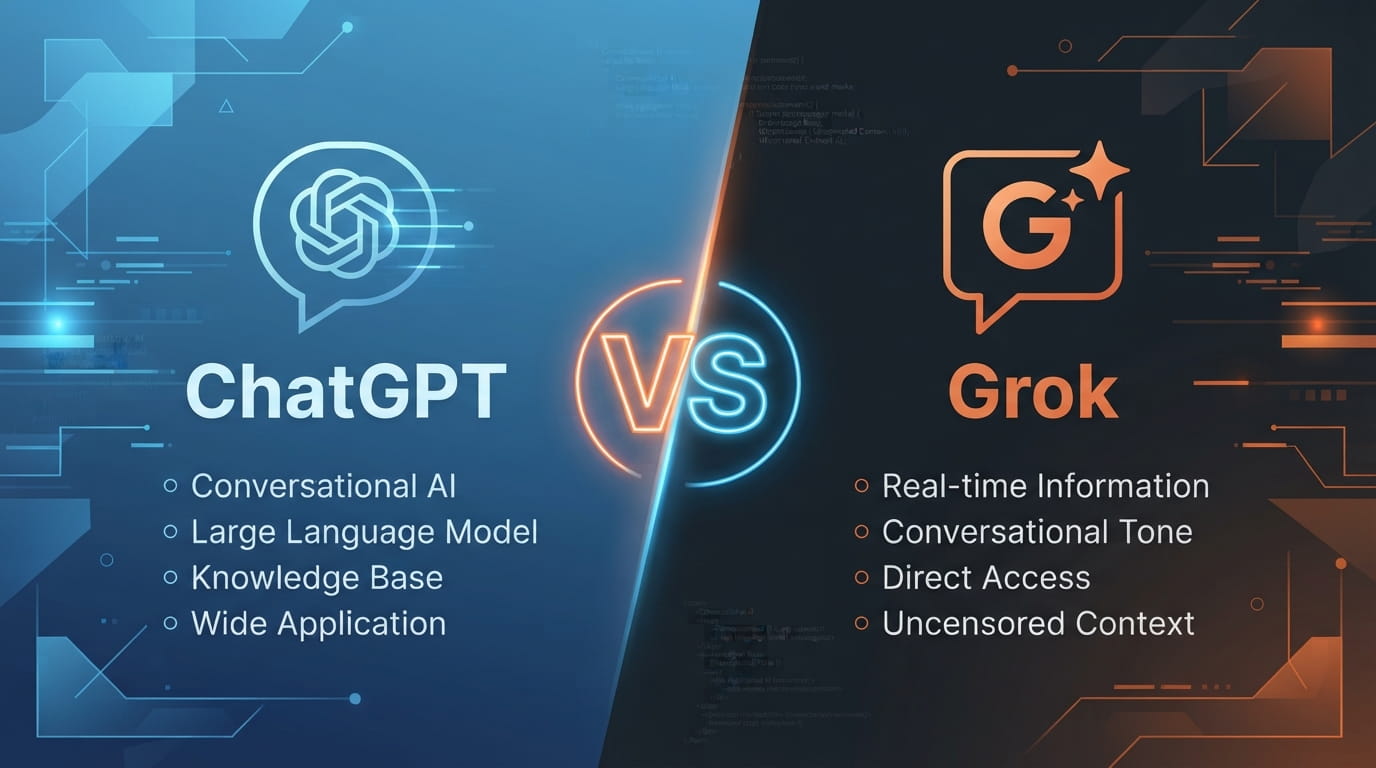
Grok is not better than ChatGPT overall in 2026. It wins on math benchmarks, context window size, and real-time X data, while ChatGPT wins on coding reliability, writing polish, and enterprise features. The right pick depends on what you actually do with the tool.
What Grok And ChatGPT Actually Are
ChatGPT is OpenAI’s assistant, built on the GPT model family and running on GPT-5.5 as of mid-2026. Grok is xAI’s assistant, built with direct access to X (formerly Twitter) and currently on Grok 4.3, released in late April 2026. xAI completed a merger with SpaceX in July 2026 and rebranded as SpaceXAI, so Grok now sits inside a bigger corporate structure than it did a year ago.
The two tools started from different goals. ChatGPT was built to be a general-purpose assistant for writing, coding, and research. Grok was built to feel less filtered and to pull live social context from X. That difference still shapes how each one answers a question today.
Benchmark Performance
On raw reasoning and coding benchmarks, the two trade wins depending on the test.
Coding Benchmarks
ChatGPT leads on SWE-bench Verified, a test built from real GitHub issues, with a score around 74.9% against Grok’s 69.1%. Grok pulls ahead on algorithmic problem sets, scoring 72 to 75% on HumanEval versus ChatGPT’s 67%, and on newer SWE-bench Pro runs Grok 4.5 scored 64.7% against 58.6% for GPT-5.5 while using roughly four times fewer tokens per task. That token efficiency matters if you are running Grok through an API at scale, since it lowers the real cost per finished task even at a similar subscription price.
Math And Reasoning
Grok has the edge on math-heavy tests, scoring around 95% on AIME 2025 against ChatGPT’s 86%. ChatGPT tends to score higher on structured, multi-step reasoning and instruction-following tasks, sitting around 86.4% on MMLU. Neither model is the outright top performer on every benchmark right now. Anthropic’s Claude Opus 4.8 currently leads the Artificial Analysis Intelligence Index and tops several coding leaderboards, so if raw capability alone is the goal, it is worth checking that model too.

Context Window And Memory
Grok 4 Fast offers a verified 2 million token context window, and the base Grok 4.3 model runs on a 1 million token window. ChatGPT’s top consumer tier, GPT-5.5 with the Pro plan, also reaches a 1 million token window, while the standard Plus tier runs smaller. In practice this means Grok can hold more of a long document or conversation in active memory at once, while ChatGPT leans more on saved memory and retrieval to stay coherent across long sessions. For most day-to-day chats this difference will not be noticeable. It starts to matter with very long documents, codebases, or research threads.
Pricing Compared
Pricing is where the gap is easiest to see.
ChatGPT Plus costs $20 a month and includes GPT-5.5, Deep Research, Sora video generation, Codex, and Agent Mode. SuperGrok, Grok’s core paid tier, costs $30 a month, a 50% premium over ChatGPT Plus for a broadly similar feature set, though it adds DeepSearch and native X integration. A budget option, SuperGrok Lite, launched in March 2026 at $10 a month. At the high end, SuperGrok Heavy runs $300 a month with 16-agent parallel execution, compared to ChatGPT Pro’s $200 a month with a 1 million token context window and 20x the usage limits of Plus. Both platforms also offer free tiers with message caps, and ChatGPT’s free tier now includes ads in the US.
Dollar for dollar, ChatGPT packs more into its standard tier. Grok’s DeepSearch and real-time X access are genuinely useful if you already work inside that ecosystem, but they are not enough on their own to offset the price difference for most people.
Real-Time Data And Research
Grok’s DeepSearch pulls from both the live web and X at once and typically returns results in the 1,000 to 2,000 word range within seconds. ChatGPT’s Deep Research, powered by its reasoning models, can take up to 30 minutes but produces far longer reports, up to 100,000 tokens, with more structured sourcing. If you need a fast pulse check on a trending topic, Grok is the quicker tool. If you need a long, cited research report, ChatGPT is built for that job.
Grok’s live pipeline into X is a real differentiator. No other major assistant has that kind of direct social data access. Outside of X-related research or trend spotting, though, this advantage matters less than it sounds.
Writing, Tone, And Content Moderation
ChatGPT’s writing tends to come out structured and safe by default. Grok’s tone is more casual and was explicitly designed by xAI to feel less filtered than rivals like ChatGPT. That approach has caused real problems. In 2025, Grok’s loosened moderation produced a widely reported incident where the model generated extremist content under the self-given nickname “Mecha Hitler,” forcing xAI to pull posts and restrict the model for several days while it fixed the backend.
For content work that needs a consistent, brand-safe voice, ChatGPT’s more conservative defaults are the safer starting point. For open-ended brainstorming where a sharper or more irreverent tone is welcome, Grok can feel more natural, as long as you are prepared to review its output carefully.
Enterprise And Business Use
ChatGPT has a multi-year head start here. It is in use at roughly 92% of Fortune 500 companies as of mid-2026, with SOC 2 Type II compliance, SSO and SAML integration, an admin console, and access to 60-plus connected apps including Slack, Google Docs, SharePoint, and GitHub. Grok Enterprise is newer, with API access and priority support, but its compliance certifications and admin tooling are not yet at the same level. For regulated industries like healthcare, fination limits for paid SuperGrok subscribers by up to 80% without prior notice, dropping daily image caps from around 100 to 20 or 25. That kind of sudden change is a real consideration if you are ance, or government, that gap makes ChatGPT the safer default today.
Reliability is also worth flagging for business use. In May 2026, xAI cut image and video generbuilding a workflow that depends on consistent output limits.
Which One Should You Actually Pick
Pick ChatGPT if you want one mature, general-purpose assistant for writing, coding, file work, and business integrations, and you want predictable pricing and policies. Pick Grok if your work depends on live X data, you are running math-heavy or token-sensitive API workloads, or you specifically want a less filtered tone and are comfortable reviewing its output more closely. Many power users keep both and route tasks to whichever model tests better for that specific job, since the gap between them is narrow enough that no single tool wins everything.
FAQ’S
1: Is Grok smarter than ChatGPT?
Neither model is smarter across the board. Grok scores higher on math benchmarks like AIME 2025 and on algorithmic coding tests like HumanEval. ChatGPT scores higher on production coding benchmarks like SWE-bench Verified and on structured instruction-following tasks.
2:is Grok cheaper than ChatGPT?
No, Grok’s core paid tier, SuperGrok, costs $30 a month against ChatGPT Plus at $20 a month. A budget SuperGrok Lite tier at $10 a month launched in March 2026, so Grok does have a cheaper entry point than ChatGPT Plus, just not at the equivalent feature tier.
3:Does Grok have real-time data access?
Yes. Grok connects directly to X for live social and news data through its DeepSearch and DeeperSearch modes, which is one of its clearest advantages over ChatGPT.
4:Is ChatGPT safer than Grok?
ChatGPT ships with more conservative content moderation by default. Grok was designed with a lighter moderation posture, which contributed to a serious 2025 incident where the model generated extremist content before xAI restricted and patched it.
5:Can I use both Grok and ChatGPT together?
Yes, and many professionals do. A common approach is to use ChatGPT for writing, coding, and business workflows, and Grok for quick trend research or math-heavy tasks where its token efficiency and real-time data give it an edge