
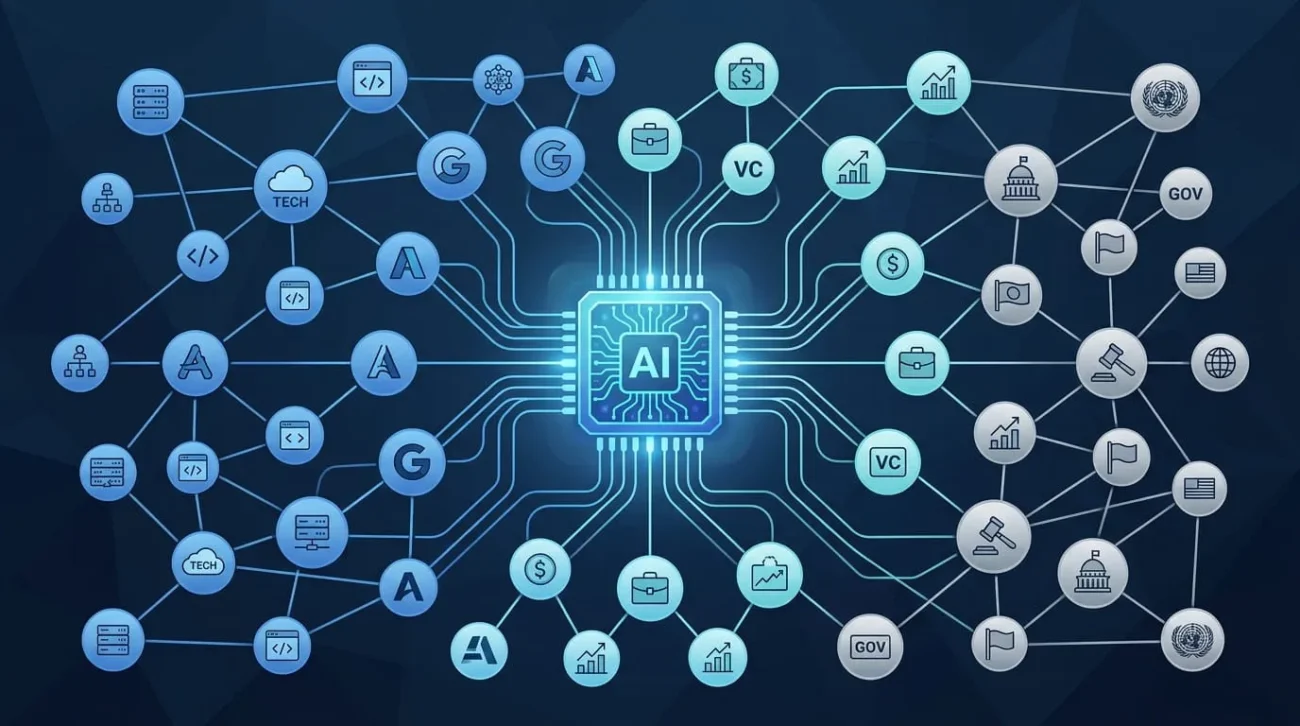
Ask who owns AI, and you will get a different answer depending on what you mean. No single person, company, or government owns artificial intelligence as a technology. It is more useful to break the question into three parts. Who owns the companies building the leading AI systems? Who owns the content those systems produce? Who is responsible for AI decisions inside a business? Each answer works differently, and mixing them up is where most confusion starts.
No One Company Controls AI as a Technology
Artificial intelligence itself is a field of research, not a product one company can hold a title to. The underlying methods, from neural networks to transformer architecture, were built through decades of academic research. Most of that foundational work is published openly and belongs to no one. What individual labs own is not the concept of AI. They own specific trained models, the data pipelines behind them, and the brand names attached to products like ChatGPT or Claude. Power over AI is spread across a handful of groups. Labs train the models. Cloud providers supply the computing power. Investors fund the training runs. Governments increasingly regulate how these systems can be built and sold. No one group in that chain has full control on its own.
Who Owns the Leading AI Companies
The clearest way to answer who owns AI is to look at the companies behind the best-known AI products. Ownership at this level is documented and traceable, even when it is spread across many investors.
OpenAI, the Company Behind ChatGPT
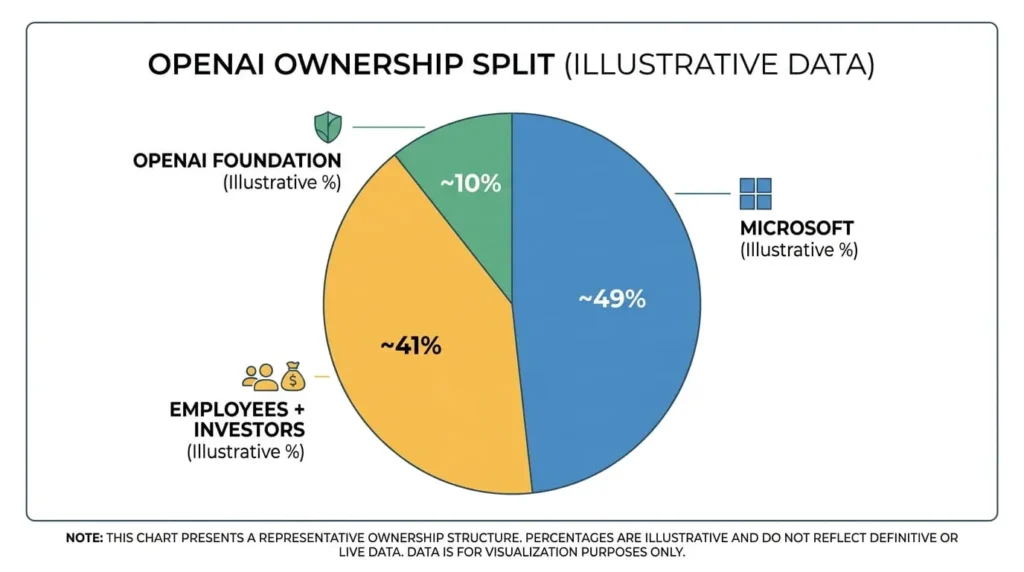
percent of that for-profit arm and appoints its entire board. Microsoft is the largest outside shareholder, holding close to 27 percent after years of investment. That stake does not come with board seats or day-to-day operating control, though. The remainder is split among current and former employees. A long list of investors who backed the company through several funding rounds holds the rest. Ownership and control are separated by design here, since the Foundation keeps governance power even though Microsoft’s economic stake is larger.
Anthropic, the Company Behind Claude
Anthropic is a privately held public benefit corporation with no majority owner. Governance sits with a Long-Term Benefit Trust, a body of independent trustees. Their job is to protect the company’s safety mission regardless of who invests. Amazon and Google are its largest financial backers, with stakes estimated in the mid-teens percentage range each. Neither holds a board seat or voting control over Anthropic’s direction. Both companies also supply cloud computing capacity to Anthropic under separate commercial deals, which is a different relationship than equity ownership. A cloud contract buys a preferred customer relationship, not a say in how the company is run.
Google DeepMind, the Team Behind Gemini
Gemini comes out of Google DeepMind, which is wholly owned by Alphabet, Google’s publicly traded parent company. Unlike OpenAI or Anthropic, there is no outside investor question here. The lab operates as an internal division rather than a separately funded startup, so its ownership follows Alphabet’s own public shareholder structure.
xAI, the Company Behind Grok
xAI was founded by Elon Musk and remains under his control. In 2026, xAI merged with Musk’s satellite company SpaceX. This folded Grok’s development into a combined entity valued in the hundreds of billions. Outside investors hold minority stakes, but Musk retains the deciding voice over how Grok is built and deployed.
Meta AI, Inside Meta Platforms
Meta AI works differently still, since it sits inside Meta Platforms, a publicly traded company. Founder Mark Zuckerberg holds a special class of shares that gives him voting control well beyond his economic stake. That structure means Meta AI answers to public shareholders on paper, but decisions in practice still run through Zuckerberg.
Who Owns Content You Create With AI
A separate question comes up almost as often. Who owns the words, images, or code an AI tool produces after you type a prompt? The answer under United States law is more restrictive than most people expect. Copyright has always required a human author. The U.S. Copyright Office has held firmly to that standard as generative tools have spread. Content produced entirely by an AI system, with no meaningful human creative input, does not qualify for copyright protection. It effectively sits outside the copyright system rather than being owned by anyone, including the AI company that built the tool.
That standard was tested directly in Thaler v. Perlmutter, a case where an inventor tried to register a fully AI-generated image with the AI system listed as the author. The Copyright Office refused the registration, and courts upheld that refusal. The Supreme Court declined to hear a further appeal in March 2026, leaving the human authorship rule firmly in place. The door is not closed on AI-assisted work, though. Say you write a detailed prompt, then meaningfully edit, arrange, or build on what the AI produces. Your own creative contribution can be copyrighted in that case. This holds even though the raw AI-generated material underneath it cannot be. The Copyright Office reviews these cases individually. It weighs how much creative control a person actually exercised over the final result. Effort spent writing the prompt is not the same thing as creative control.
Separate from copyright law, the AI platform itself sets terms of service. These terms determine what you are allowed to do with an output, such as using it commercially or reselling it. Most major providers assign users whatever rights the provider holds to the output. That contractual permission is not the same thing as a copyright, though. It does not make an otherwise uncopyrightable work legally protectable against someone else copying it.
Who Owns AI Decisions Inside a Business
A third version of this question shows up inside companies adopting AI tools. It has nothing to do with technology ownership at all, since it is really about accountability. Which department decides which AI tools to license? Who governs how they get used, and who answers for the outcomes? In practice, that responsibility usually lands somewhere between IT, legal, and whichever business unit is closest to the use case. Companies that treat AI adoption as one department’s project tend to stall. Those that build a cross-functional group tend to move faster instead. Clear decision rights and a shared understanding of risk help them avoid buying duplicate tools.
Why the Ownership Question Actually Matters

Who owns an AI company shapes what its products will and will not do. Investors and governance structures influence priorities even without formal control over daily decisions. Who owns AI-generated output determines whether a business can defend its content against copying elsewhere. It also determines whether that business is exposed to a claim from someone else over the same material. Both questions are still evolving. Corporate ownership structures shift with each new funding round, and copyright guidance is still being shaped by ongoing litigation. Several lawsuits over AI training data are also working their way through appellate courts right now. Their outcomes could reshape what AI companies are allowed to build their models on in the first place. Anyone using AI commercially should expect the answer to keep changing rather than settling into a fixed rule anytime soon.